C_ABAPD_2507 Pass Test & C_ABAPD_2507 Study Test
Wiki Article
2026 Latest Actual4dump C_ABAPD_2507 copyright and C_ABAPD_2507 copyright Free Share: https://drive.google.com/open?id=1HsBu4ZZx038ONfYItR5SWgWooEI0ao8o
Studying with updated C_ABAPD_2507 practice questions improve your skills of clearing the certification test in a short time. Actual4dump makes it easy for you to prepare successfully for the C_ABAPD_2507 Questions in a short time with C_ABAPD_2507 Dumps. The product of Actual4dump has been prepared under the expert supervision of thousands of experts worldwide.
SAP C_ABAPD_2507 Exam copyright Topics:
| Topic | Details |
|---|---|
| Topic 1 |
|
| Topic 2 |
|
| Topic 3 |
|
Latest Updated C_ABAPD_2507 Pass Test - SAP SAP Certified Associate - Back-End Developer - ABAP Cloud Study Test
The PDF version of our C_ABAPD_2507 learning guide is convenient for reading and supports the printing of our study materials. If client uses the PDF version of C_ABAPD_2507 exam questions, they can download the demos freely. If clients feel good after trying out our demos they will choose the full version of the test bank to learn our C_ABAPD_2507 Study Materials. And the PDF version can be printed into paper documents and convenient for the client to take notes.
SAP Certified Associate - Back-End Developer - ABAP Cloud Sample Questions (Q69-Q74):
NEW QUESTION # 69
What RAP object contains only the fields required for a particular app?
- A. Projection view
- B. Database view
- C. Data model view
- D. Metadata extension
Answer: A
Explanation:
Comprehensive and Detailed Explanation from Exact Extract:
* In RAP, the Projection View is designed to expose only the fields relevant for a specific app, keeping the UI lean and controlled.
* Metadata extension # adds UI-related metadata, not fields.
* Database view # technical representation, not app-specific.
* Data model view # defines the data structure, not app-specific projection.
* Verified by RAP documentation: Projection views are application-specific representations of the underlying data model.
Study Guide Reference: SAP RAP Help - Business Object Projection Layer.
NEW QUESTION # 70
What is the syntax to access component carrier_name of structure connection?
- A. connection=>carrier_name
- B. connection>carrier_name
- C. connection/carrier_name
- D. connection-carrier_name
Answer: D
Explanation:
Comprehensive and Detailed Explanation From Exact Extract:
* In ABAP, structure component access uses the hyphen (-): structure-component. The other tokens are used for different purposes: -> for object reference attributes, => for static components, and / is not a field selector in ABAP.
* ABAP Cloud stresses typed APIs and static checks, ensuring misuse of component selectors is caught early; correct structure access with - is part of the enforced style.
NEW QUESTION # 71
What are some features of a unique secondary key? Note: There are 2 correct answers to this question.
- A. It is created with the first read access of a table.
- B. It is updated when the modified table is read again.
- C. It is updated when the table is modified.
- D. It is created when a table is filled.
Answer: A,C
Explanation:
A unique secondary key is a type of secondary key that ensures that the key combination of all the rows in a table is unique. A unique secondary key has two purposes: firstly, to speed up access to the table, and secondly, to enforce data integrity1.
It is created with the first read access of a table: This is true. A unique secondary key is created when an internal table is filled for the first time using the statement READ TABLE or a similar statement. The system assigns a name and an index to each row of the table based on the key fields23.
It is updated when the modified table is read again: This is false. A unique secondary key does not need to be updated when the internal table content changes, because it already ensures data uniqueness. The system uses a lazy update strategy for non-unique secondary keys, which means that it delays updating them until they are actually accessed23.
You cannot do any of the following:
It is created when a table is filled: This is false. As explained above, a unique secondary key is created only with the first read access of a table23.
It is updated when the modified table is read again: This is false. As explained above, a unique secondary key does not need to be updated when the internal table content changes23.
NEW QUESTION # 72
In what order are objects created to generate a RESTful Application Programming application?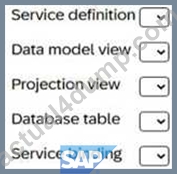
- A. Database table
- B. Projection view
- C. Service definition
- D. Data model view
- E. Service binding
Answer: A,B,C,D,E
NEW QUESTION # 73
What are the effects of this annotation? Note: There are 2 correct answers to this question.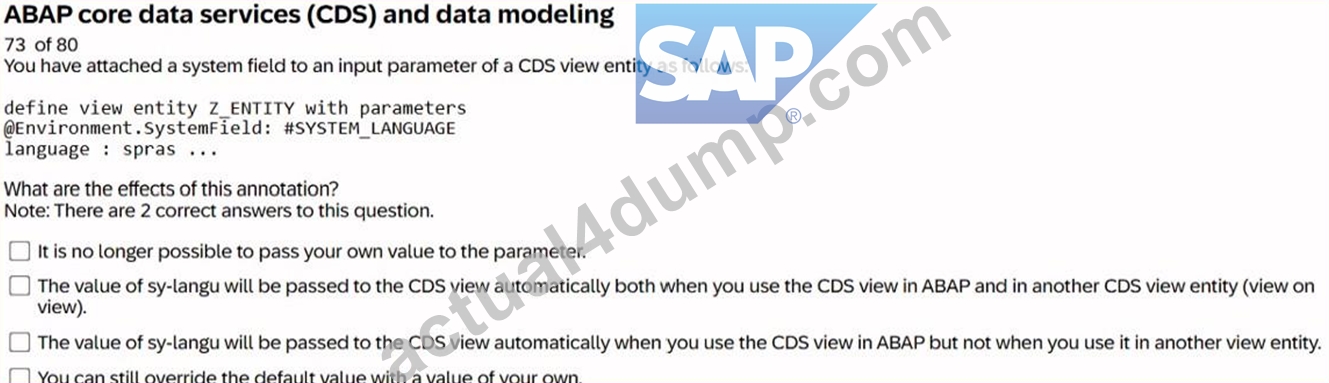
- A. The value of sy-langu will be passed to the CDS view automatically when you use the CDS view in ABAP but not when you use it in another view entity
- B. You can still override the default value with a value of your own.
- C. The value of sy-langu will be passed to the CDS view automatically both when you use the -1 CDS view in ABAP and in another CDS view entity (view on view).
- D. It is no longer possible to pass your own value to the parameter.
Answer: B,C
Explanation:
The annotation @Environment.systemField: #LANGUAGE is used to assign the ABAP system field sy-langu to an input parameter of a CDS view or a CDS table function. This enables the implicit parameter passing in Open SQL, which means that the value of sy-langu will be automatically passed to the CDS view without explicitly specifying it in the WHERE clause. This also applies to the CDS views that use the annotated CDS view as a data source, which means that the value of sy-langu will be propagated to the nested CDS views (view on view)12. For example:
The following code snippet defines a CDS view ZI_FLIGHT_TEXTS with an input parameter p_langu that is annotated with @Environment.systemField: #LANGUAGE:
define view ZI_FLIGHT_TEXTS with parameters p_langu : syst_langu @<Environment.systemField: #LANGUAGE as select from sflight left outer join scarr on sflight.carrid = scarr.carrid left outer join stext on scarr.carrid = stext.carrid { sflight.carrid, sflight.connid, sflight.fldate, scarr.carrname, stext.text as carrtext } where stext.langu = :p_langu The following code snippet shows how to use the CDS view ZI_FLIGHT_TEXTS in ABAP without specifying the value of p_langu in the WHERE clause. The value of sy-langu will be automatically passed to the CDS view:
SELECT carrid, connid, fldate, carrname, carrtext FROM zi_flight_texts INTO TABLE @DATA(lt_flights).
The following code snippet shows how to use the CDS view ZI_FLIGHT_TEXTS in another CDS view ZI_FLIGHT_REPORT. The value of sy-langu will be automatically passed to the nested CDS view ZI_FLIGHT_TEXTS:
define view ZI_FLIGHT_REPORT with parameters p_langu : syst_langu @<Environment.systemField: #LANGUAGE as select from zi_flight_texts(p_langu) { carrid, connid, fldate, carrname, carrtext, count(*) as flight_count } group by carrid, connid, fldate, carrname, carrtext The annotation @Environment.systemField: #LANGUAGE does not prevent the possibility of overriding the default value with a value of your own. You can still specify a different value for the input parameter p_langu in the WHERE clause, either in ABAP or in another CDS view. This will override the value of sy-langu and pass the specified value to the CDS view12. For example:
The following code snippet shows how to use the CDS view ZI_FLIGHT_TEXTS in ABAP with a specified value of p_langu in the WHERE clause. The value 'E' will be passed to the CDS view instead of the value of sy-langu:
SELECT carrid, connid, fldate, carrname, carrtext FROM zi_flight_texts WHERE p_langu = 'E' INTO TABLE @DATA(lt_flights).
The following code snippet shows how to use the CDS view ZI_FLIGHT_TEXTS in another CDS view ZI_FLIGHT_REPORT with a specified value of p_langu in the WHERE clause. The value 'E' will be passed to the nested CDS view ZI_FLIGHT_TEXTS instead of the value of sy-langu:
define view ZI_FLIGHT_REPORT with parameters p_langu : syst_langu @<Environment.systemField: #LANGUAGE as select from zi_flight_texts(p_langu) { carrid, connid, fldate, carrname, carrtext, count(*) as flight_count } where p_langu = 'E' group by carrid, connid, fldate, carrname, carrtext
NEW QUESTION # 74
......
The C_ABAPD_2507 quiz torrent we provide is compiled by experts with profound experiences according to the latest development in the theory and the practice so they are of great value. Please firstly try out our product before you decide to buy our product. It is worthy for you to buy our C_ABAPD_2507 Exam Preparation not only because it can help you pass the C_ABAPD_2507 exam successfully but also because it saves your time and energy. Your satisfactions are our aim of the service and please take it easy to buy our C_ABAPD_2507 quiz torrent.
C_ABAPD_2507 Study Test: https://www.actual4dump.com/SAP/C_ABAPD_2507-actualtests-dumps.html
- Actual C_ABAPD_2507 Test Pdf ???? C_ABAPD_2507 Reliable Learning Materials ???? C_ABAPD_2507 Reliable Learning Materials ???? Search for ➡ C_ABAPD_2507 ️⬅️ and download it for free immediately on ▛ www.prepawaypdf.com ▟ ????Best C_ABAPD_2507 Vce
- Pass Guaranteed Quiz 2026 C_ABAPD_2507: Trustable SAP Certified Associate - Back-End Developer - ABAP Cloud Pass Test ???? Search for ☀ C_ABAPD_2507 ️☀️ and download exam materials for free through ➥ www.pdfvce.com ???? ????C_ABAPD_2507 Test Valid
- C_ABAPD_2507 Reliable Test Tips ???? C_ABAPD_2507 Test Study Guide ⬆ C_ABAPD_2507 Test Valid ???? Search for ▶ C_ABAPD_2507 ◀ and download it for free immediately on ⏩ www.testkingpass.com ⏪ ⤴C_ABAPD_2507 Test Free
- Avail Realistic C_ABAPD_2507 Pass Test to Pass C_ABAPD_2507 on the First Attempt ???? Search for “ C_ABAPD_2507 ” and download it for free on ➤ www.pdfvce.com ⮘ website ????C_ABAPD_2507 Related Content
- New C_ABAPD_2507 Exam Duration ???? C_ABAPD_2507 Related Content ???? C_ABAPD_2507 Reliable Exam Online ???? Search for ➤ C_ABAPD_2507 ⮘ and download it for free on 《 www.exam4labs.com 》 website ????Actual C_ABAPD_2507 Test Pdf
- 100% Pass Quiz 2026 C_ABAPD_2507: High-quality SAP Certified Associate - Back-End Developer - ABAP Cloud Pass Test ???? Search for ➽ C_ABAPD_2507 ???? and download it for free immediately on “ www.pdfvce.com ” ????C_ABAPD_2507 Reliable Test Tips
- C_ABAPD_2507 Related Content ???? Latest C_ABAPD_2507 Exam Test ???? Pass Leader C_ABAPD_2507 Dumps ???? Download ▷ C_ABAPD_2507 ◁ for free by simply searching on 【 www.vceengine.com 】 ????Certification C_ABAPD_2507 Test Answers
- Professional SAP C_ABAPD_2507 Pass Test | Try Free Demo before Purchase ???? Go to website ➽ www.pdfvce.com ???? open and search for ➽ C_ABAPD_2507 ???? to download for free ????C_ABAPD_2507 Reliable Exam Online
- Avail Realistic C_ABAPD_2507 Pass Test to Pass C_ABAPD_2507 on the First Attempt ???? Search on ▷ www.pdfdumps.com ◁ for ⏩ C_ABAPD_2507 ⏪ to obtain exam materials for free download ????Latest C_ABAPD_2507 Exam Test
- Latest C_ABAPD_2507 Exam Test ???? C_ABAPD_2507 Test Cram Pdf ???? Latest C_ABAPD_2507 Exam Test ???? Search for ➠ C_ABAPD_2507 ???? and easily obtain a free download on “ www.pdfvce.com ” ⚖Latest C_ABAPD_2507 Exam Test
- SAP C_ABAPD_2507 Desktop Practice Exam Questions Software ???? Search for ⇛ C_ABAPD_2507 ⇚ and download it for free immediately on ⮆ www.vceengine.com ⮄ ????C_ABAPD_2507 Test Cram Pdf
- www.stes.tyc.edu.tw, zoebquj010966.activablog.com, impulsedigital.in, fortunetelleroracle.com, www.stes.tyc.edu.tw, www.stes.tyc.edu.tw, www.stes.tyc.edu.tw, acupressurelearning.com, shepdidd.alboompro.com, arunllya874868.mdkblog.com, Disposable vapes
BONUS!!! Download part of Actual4dump C_ABAPD_2507 dumps for free: https://drive.google.com/open?id=1HsBu4ZZx038ONfYItR5SWgWooEI0ao8o
Report this wiki page